
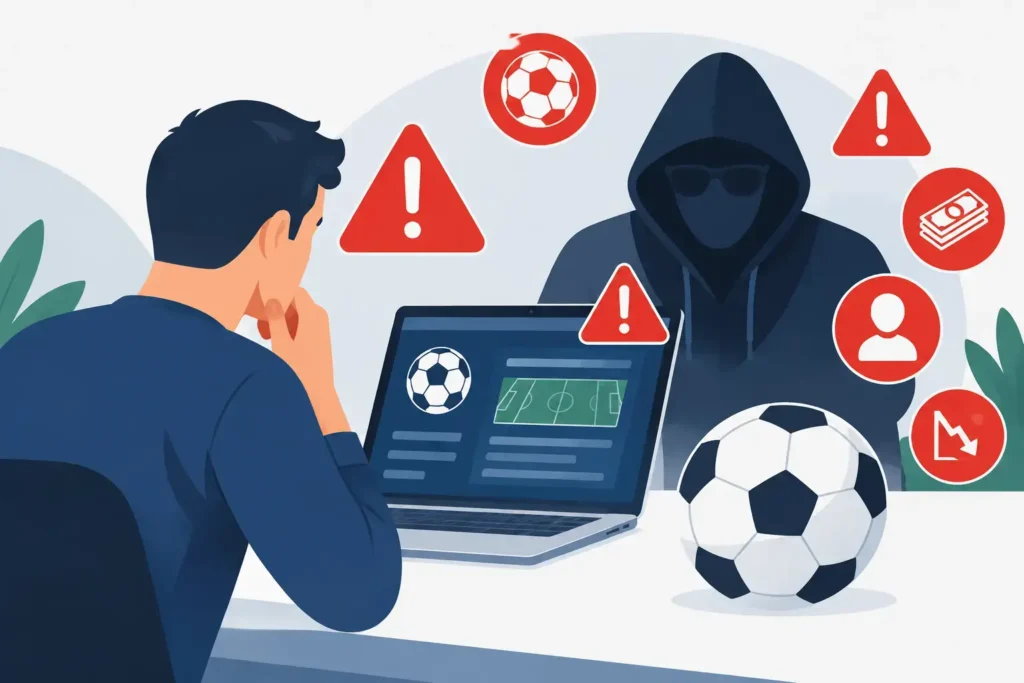
A losing bet is part of football betting. A tipster who hides losses, invents a winning record, and disappears after taking payment is something else entirely. Soccer tipster scams exploit the same emotion that makes betting exciting: the belief that one “certain” pick can erase a bad weekend and change your bankroll overnight.
Serious bettors do not need magic. They need credible analysis, fair odds, a verifiable record, and enough discipline to judge results over a meaningful run of bets. Football is mathematics, but only when the numbers are real. Here is how to identify the operators selling fantasy instead of betting value.
Why soccer tipster scams are so convincing
Scammers understand the bettor’s pain points. You have watched a strong team dominate, backed them with confidence, and seen a late red card or missed penalty destroy the ticket. After a few frustrating losses, a stranger promising “fixed matches” or 95% accuracy can sound tempting.
Their sales pitch is built around urgency. There is supposedly one final slot in a VIP group, a match that must be bought before kickoff, or a confidential source that will disappear if you hesitate. The goal is not to help you make better betting decisions. It is to stop you from asking basic questions.
A real betting service can be confident in its process while still being honest about risk. No analyst controls injuries, referee decisions, weather, team selection, or the bounce of the ball. Anyone selling certainty in a sport decided by 90-plus minutes of chaos is selling a story.
The red flags that should stop you from paying
1. Guaranteed wins, fixed games, or “no risk” claims
There are no legitimate guaranteed bets. Even when a favorite is heavily supported by form, squad quality, and market movement, the outcome remains uncertain. “Fixed match” offers are especially dangerous. They are usually recycled scams designed to separate bettors from their money before a game begins.
The same applies to claims that a ticket is impossible to lose. Betting is about probability and price, not certainty. A tipster who cannot say the word “loss” is not protecting your bankroll.
2. A perfect record with no proof
A long winning run can happen. A permanent 100% record cannot be trusted without transparent, time-stamped evidence. Many dishonest sellers delete losing posts, edit old messages, publish picks after matches have started, or show only winning slips from dozens of unmentioned bets.
Look beyond screenshots. A betting slip can be cropped, edited, placed after the fact, or funded with a tiny stake while the seller claims a huge investment. What matters is a complete historical record: the selection, odds available when it was posted, stake approach, result, and every loss.
3. Unrealistic profit claims with no betting context
“Turn $50 into $5,000 this week” is marketing for desperation, not a betting strategy. High returns may be possible over a short period, but they are not a stable promise. The higher the claimed reward, the more important it is to understand the risk and volatility behind it.
Ask what odds the service targets and how it measures performance. A tipster offering mostly 1.10 odds may advertise a high hit rate but provide little room for error. Another may chase 8.00 accumulators that look exciting but lose most weeks. Neither approach tells you much without a clear long-term record and realistic bankroll plan.
4. Pressure to pay by irreversible methods
Be cautious when a seller insists on crypto transfers, gift cards, personal payment accounts, or any method that gives you no meaningful way to challenge a transaction. These options are not automatically fraudulent, but the combination of anonymous payment, urgent pressure, and no accountable business identity is a serious warning.
Reliable services make their offer clear before payment. You should know what package you are buying, how long access lasts, what type of markets are covered, and when picks are normally delivered. Confusion is useful to a scammer because it creates room to change the terms later.
5. A private group full of hype and no analysis
A group packed with fire emojis, luxury photos, and “we never lose” comments can create social proof without providing any football insight. Often, critical comments are deleted and losing members are removed. You are left seeing only the promotional version of the group.
Good analysis does not need to reveal every proprietary calculation, but it should show a logical case for the bet. Team form, expected lineups, injuries, motivation, tactical matchups, schedule pressure, and the market price all matter. If the only explanation is “my source says so,” walk away.
6. Constantly changing identities and pages
Scammers frequently abandon accounts after a losing streak or wave of complaints. They return with a new profile, a new logo, and a new claim of being the “most trusted” tipster online. Check whether the person or business has a consistent identity and a history that extends beyond recent winning screenshots.
A legitimate operation does not need to reinvent itself after every bad result. Losses are part of an honest record. Hiding them is the problem.
7. Picks that arrive after the price has gone
Odds are not fixed. A good selection at 2.10 can become poor value at 1.65 once the market moves. Some tipsters advertise a winning price that was available for seconds, was never widely available, or was posted after followers could realistically place the wager.
This is why timing matters. Before subscribing, find out whether picks are released early enough to act on, which sportsbooks or markets the quoted odds reflect, and whether the service records the price at the time of publication. A tip is only useful if you can access something close to the stated value.
8. Accumulators presented as a serious betting system
A four-team parlay can be entertaining, but it multiplies risk and bookmaker margin. Scam sellers love giant potential payouts because they are easy to market in screenshots. One winning accumulator can fuel weeks of promotion while dozens of losers are forgotten.
That does not mean every multiple is bad. It means you should treat it honestly: as a higher-variance bet, not a dependable income plan. For a more controlled approach, many bettors focus on carefully selected singles at odds that offer genuine value, often above 1.80, with stakes they can afford to lose.
How to judge a football prediction service properly
Start with accountability. Can you see a consistent, dated record that includes wins and losses? Are odds stated clearly? Does the service explain its market focus and avoid claims of guaranteed profit? These are basic standards, not special favors.
Next, judge the process rather than one hot streak. A credible football prediction service looks for a gap between the bookmaker’s price and its estimated probability. It may use team news, underlying performance data, tactical trends, fixture congestion, and league-specific knowledge. The exact method can vary, but there should be a method.
Then consider whether the service fits your own betting style. If you only want weekend action, daily picks released at the last minute may not suit you. If you prefer singles, do not pay for a product built around high-risk parlays. A good service gives you enough clarity to make that decision before money changes hands.
Tipforwin’s approach is based on the part scammers usually avoid: consistent selection, odds-based thinking, and results judged over time rather than one loud winning ticket. That is the standard worth demanding from any provider, paid or free.
Protect your bankroll before you protect your ego
The strongest defense against fraud is refusing to chase. Set a betting budget, use a consistent stake size, and do not increase your stake because a stranger claims the next match is certain. If a tip loses, record it. If a service loses repeatedly, review the evidence and move on instead of paying more to recover faster.
Bet only where it is legal for you, and keep football betting in its proper place: a calculated form of entertainment with financial risk. The best tipster will still have losing days. The difference is that a legitimate analyst gives you a transparent basis for the bet, while a scammer gives you a promise designed to bypass your judgment.
Before you buy any pick, slow down. Demand the record, check the odds, understand the risk, and make sure the decision still makes sense after the hype is gone.