
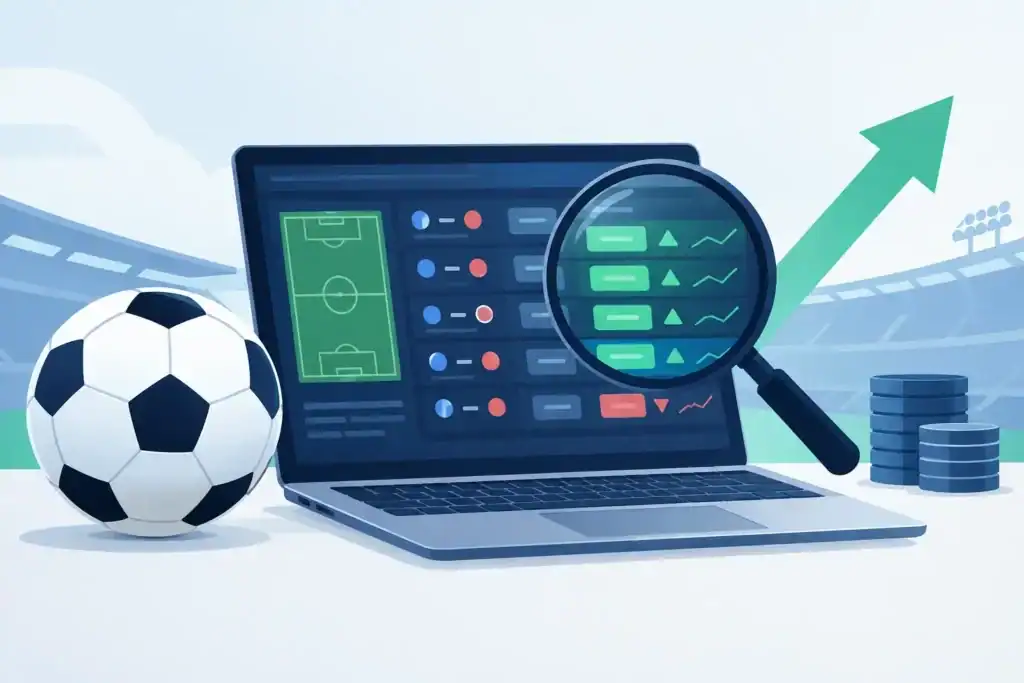
A match can look obvious at 9:00 a.m. and overpriced by kickoff. That is why soccer odds scanners matter. They help bettors compare markets, flag unusual price differences, and focus attention where the numbers may be telling a different story than the public narrative.
For serious football bettors, the goal is not to place more bets because a scanner produces more alerts. The goal is to identify prices worth taking before the market corrects them. Football is mathematics, but mathematics only works when you use it with discipline, team analysis, and sensible bankroll control.
What Soccer Odds Scanners Actually Do
Soccer odds scanners collect and compare odds across betting markets. Depending on the tool, they may highlight differences between sportsbooks, sudden line movement, arbitrage opportunities, value estimates, or markets where a price sits outside the wider consensus.
That sounds simple, but the real advantage is speed. A bettor covering the Premier League, Bundesliga, Champions League, Ligue 1, and Europa League cannot manually inspect every match, every market, and every bookmaker throughout the day. A scanner narrows the board. It tells you where to look first.
A useful scanner can surface a home win priced at 2.05 in one place while comparable markets sit closer to 1.85 elsewhere. It can show that both teams to score is shortening quickly after team news.
None of that automatically means you have found a winning bet. Odds move for valid reasons, and a single bookmaker can be slow, conservative, or simply managing its own exposure. The scanner finds a possible edge. Your job is to decide whether the edge is real.
Why Odds Differences Create Betting Opportunities
Bookmakers do not price matches in isolation. They respond to injury news, expected lineups, weather, schedule pressure, sharp money, public betting, and prices offered by competitors. Their numbers are also built with margin included. This creates small inconsistencies, especially in lower-profile leagues and fast-moving pre-match windows.
The strongest betting decisions happen when scanner data and football logic point in the same direction. If an odds scanner flags a high price on over 2.5 goals, check whether both teams have attacking absences or whether the match is expected to be played in heavy rain. If the football case contradicts the price alert, pass. There will always be another match.
Value is not the same as picking the favorite. A 1.35 favorite can win and still be a poor bet if its true chance is closer to 65 percent than the 74 percent implied by the odds. On the other hand, an underdog at 3.20 can lose while still being the correct long-term selection if the price was too high for its actual chance.
That is the mindset that separates organized bettors from people chasing screenshots and lucky accumulators. You are not trying to predict every result perfectly. You are trying to repeatedly take prices that are better than the probability you assign to an outcome.
How to Use a Soccer Odds Scanner Properly
Start by choosing the markets you understand. The 1X2 market, over/under goals, both teams to score, and Asian handicaps are usually enough. There is no benefit in scanning corners, cards, player props, and obscure specials if you do not have a clear method for evaluating them.
Then set filters that match your betting style. If you focus on odds above 1.80, do not let a page full of 1.20 favorites distract you. If your strongest analysis comes from top European leagues, prioritize those competitions instead of forcing opinions on every fixture in the database.
Once an alert appears, ask a short set of questions before betting. Is the price genuinely higher than the market average? Has there been meaningful team news? Does recent form support the selection, or is it misleading because of weak opponents and unusual red cards? Is the match important to both sides? And, most importantly, would you still take this bet if the scanner had not highlighted it?
That last question protects you from blind dependence. A scanner is a research tool, not a replacement for judgment. The best bettors combine the speed of technology with a repeatable football process.
Check the Timing of the Alert
Timing changes the meaning of every odds movement. Early odds often carry more uncertainty because confirmed lineups are not available. That can create excellent value, particularly when your team news is stronger than the market’s. It can also create unnecessary risk.
Closer to kickoff, the market usually becomes more efficient. Starting lineups, late injuries, rotation, and motivational factors are clearer. Prices may be tighter, but the information is better. It depends on your edge. Some bettors specialize in opening lines, while others wait for last-hour opportunities when team sheets reshape the match.
Avoid chasing a number after it has already moved. If you liked over 2.5 goals at 2.00 and the market drops to 1.70, the original value may be gone. A good prediction at a bad price is still a bad bet.
Compare More Than One Market
A scanner alert becomes more useful when other markets confirm the same idea. Suppose a team’s win price shortens and the opponent’s team total under begins to fall. Together, those signals suggest the market is upgrading the favorite’s defensive and overall chances.
But mixed signals deserve caution. If a favorite shortens while over 2.5 goals rises, the market may expect a controlled win rather than an open match. That could make the straight win more attractive than a goals bet. Reading the relationship between markets often produces better decisions than reacting to one highlighted number.
The Limits Bettors Must Respect
Soccer odds scanners are powerful, but they cannot measure everything. They do not always understand a coach protecting key players before a cup tie. They may not capture dressing-room problems, tactical mismatches, travel fatigue, or a striker returning from injury with restricted minutes.
They also cannot solve poor bankroll management. Even a positive-value strategy has losing runs. If you stake too aggressively, you can damage your bankroll before the long-term logic has time to work. Flat stakes or a conservative percentage of bankroll make far more sense than doubling after every loss.
Arbitrage alerts deserve extra care as well. The theoretical profit can disappear when odds change, limits are applied, rules differ between sportsbooks, or one side of the bet is voided under a different market definition. What looks risk-free on a screen can become a stressful mistake if you do not understand settlement rules and execution speed.
Be especially skeptical of scanners that promise guaranteed profit. No honest betting system can guarantee results in football. A credible tool gives you data, context, and better opportunities to investigate. It does not remove uncertainty from a sport decided by missed penalties, deflections, and late red cards.
Build a Scanner Into a Repeatable System
The most profitable use of a scanner is boring in the best way. Create a shortlist, analyze the matches, record the price you took, and review the result later without judging the decision solely by whether it won. Over time, you will see which leagues, odds ranges, and markets actually suit your method.
Keep notes on closing line value too. If you regularly take a selection at 2.00 and it closes at 1.80, that is evidence your pricing process may be sound, even if individual bets lose. If your bets repeatedly drift after you place them, review your assumptions instead of blaming variance every time.
At Tipforwin, this is the standard worth aiming for: use data to locate the opportunity, apply match analysis to test it, and stay disciplined enough to let a long-term process do its work. The best football prediction is not the loudest claim. It is the bet you can explain with numbers, team information, and a price that makes sense.
The next time a scanner flashes an alert, do not rush to click. Pause, compare the market, test the football case, and ask whether the odds still offer value. That extra minute can be the difference between following noise and making a calculated betting decision.