
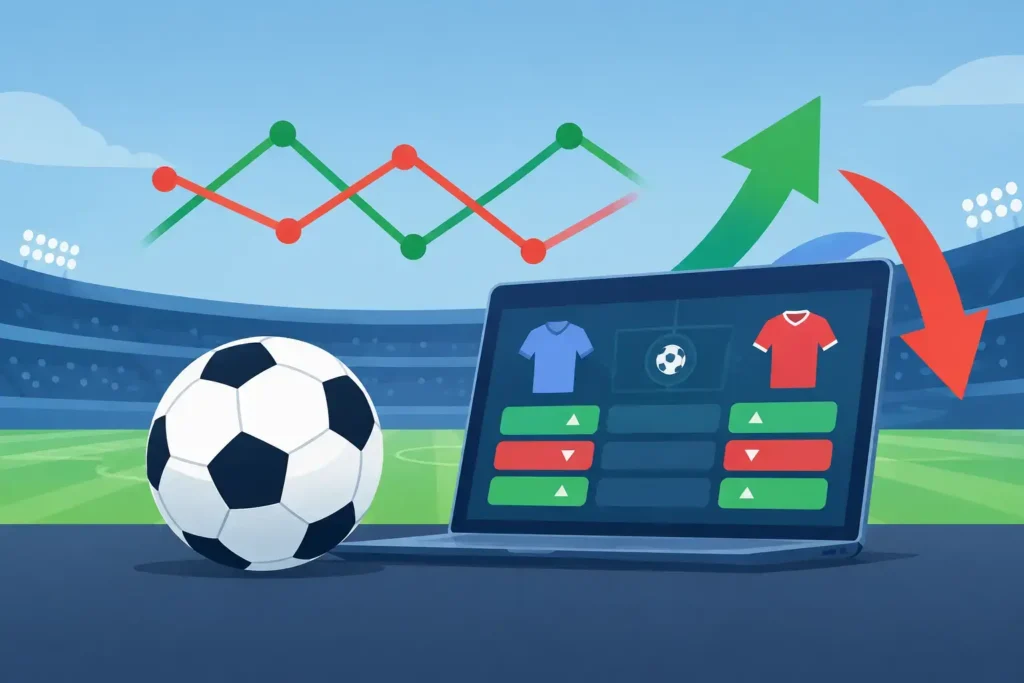
A Premier League favorite opens at 1.95 on Monday, drifts to 2.15 by Thursday, then closes at 1.82 an hour before kickoff. If you have asked, “why do soccer odds change,” this is the answer in real time: the market is constantly processing new information, new money, and the opinions of bettors who are willing to risk serious stakes.
Odds are not fixed predictions. They are moving prices. A sportsbook posts an opening line, measures the risk it is taking, reacts to team news and market activity, and adjusts. For bettors, that movement matters because the number you take determines whether a correct reading of a match produces long-term profit or merely another bet.
Why Do Soccer Odds Change in the First Place?
Soccer odds move because the implied probability of an outcome changes, or because the sportsbook needs to manage its exposure. Often, both happen at once.
At 2.00 decimal odds, a selection has an implied probability of 50 percent before the bookmaker’s margin. If that same selection falls to 1.80, the market is now treating it as more likely to happen. That does not automatically mean it will win. It means the available price has become less generous because the market believes the original line was too high, or because enough respected money forced an adjustment.
The key point is simple: odds movement is information, but it is not a betting instruction. A falling price can confirm strong analysis. It can also mean you missed the best number and are now being invited to chase a bet with reduced value.
The Biggest Reasons Soccer Betting Odds Move
Team News Changes the True Strength of a Side
Confirmed lineups are one of the strongest drivers of late movement. A star striker, dominant center back, creative midfielder, or first-choice goalkeeper can change the way a match should be priced. In soccer, one absent player can matter even more when the squad lacks depth or the replacement does not fit the system.
Suppose a team is priced at 2.10 away from home. News that its leading scorer is ruled out may push that number toward 2.30 or higher. On the other side, the opponent’s odds shorten. The exact shift depends on the player, the fixture, available replacements, and whether the market had already anticipated the absence.
This is why betting from old injury news is dangerous. A player listed as doubtful on Tuesday may be fully fit on Saturday. Another may be officially available but only ready for a short substitute appearance. Serious analysis separates headlines from expected minutes and tactical impact.
Sharp Money Finds a Bad Opening Price
Sportsbooks employ oddsmakers, data models, and trading teams. Still, opening lines are not perfect. They are an early estimate, particularly in smaller leagues, youth competitions, reserve matches, or games with limited reliable information.
Professional bettors look for those errors. If several respected bettors attack a price, bookmakers pay attention because those wagers are more informative than a large volume of casual money. The sportsbook may cut the odds quickly, even if most public bets are on the other side.
This is commonly called sharp money. It is not magical insider knowledge. It is usually the result of faster team news, better models, stronger league specialization, or a clearer understanding of how a matchup will play out.
Public Betting Can Move High-Profile Games
In the Champions League, Premier League, and major international tournaments, public opinion has more influence. Famous clubs attract bets regardless of price. A team like Real Madrid, Manchester City, or Bayern Munich can be backed heavily by casual bettors simply because people know the squad and expect goals.
Bookmakers are not always moving a line because they agree with the public. Sometimes they move it to reduce liability. If a huge percentage of tickets land on a popular favorite, the sportsbook may shorten that team’s odds and improve the price on the underdog to attract balancing action.
That creates opportunity, but only when the market has overreacted. Betting against public teams just because they are popular is not a strategy. The correct question is whether the new price is higher than your calculated probability justifies.
Limits and Market Liquidity Affect Early Prices
A market at 9 a.m. on Monday is not the same market as it is at 2 p.m. on Saturday. Early in the week, many sportsbooks accept lower limits. One well-informed bet can move an opening line because there is not much money available to absorb it.
As kickoff approaches, limits increase and the market becomes more liquid. More bettors participate, lineup information arrives, and prices often become sharper. Major leagues tend to have efficient closing markets because thousands of people and multiple bookmakers are evaluating the same match.
Smaller leagues can behave differently. Odds may move dramatically on limited action, then reverse once better information appears. That is why a price movement in a low-liquidity league deserves more investigation than blind trust.
Weather, Scheduling, and Motivation Matter
Not every move comes from a headline player injury. Heavy rain, high winds, poor field conditions, long travel, fixture congestion, and a difficult turnaround after European competition can affect the expected tempo and scoring environment.
Motivation also matters, especially late in a season. A team fighting relegation, protecting a title lead, or needing only a draw in a two-leg tie may approach a match differently from a side with nothing meaningful left to play for. Markets can move when managers signal rotation or when the tactical incentives become clear.
These factors are easy to overrate. “Must-win” is not a measurable advantage by itself. A desperate team can become rushed, exposed, and inefficient. Use motivation as context alongside form, squad quality, expected lineups, and the price.
What Odds Movement Means for Value Bettors
The most useful betting question is not whether odds moved. It is whether you can still get value after they moved.
Imagine your analysis gives a home team a 55 percent chance to win. Fair decimal odds would be around 1.82. If the sportsbook opens at 2.00, you have a potential value bet. If sharp money pushes the price to 1.78 before you place your wager, the edge is gone. The team may still win, but the bet is no longer attractive at that number.
This is where discipline separates a calculated bettor from someone chasing every market signal. Do not bet a selection because it moved from 2.20 to 1.90. Ask what changed, whether it was already known, and whether 1.90 still beats your own fair price.
At Tipforwin, the focus is on identifying odds that offer room for value, not celebrating a winner after the market has already corrected the number. Football is mathematics over a large sample. A single result can be chaotic. Consistently taking better prices is one of the few parts of betting you can control.
How to Read Market Moves Without Getting Trapped
Start by recording the opening odds, the current odds, and the timing of the move. A steady shift across several sportsbooks is more meaningful than one isolated bookmaker changing a line. Then look for a reason: lineup news, injury confirmation, weather, a suspension, or a credible tactical update.
Be especially careful with dramatic late moves. They can be caused by confirmed starting elevens, but they can also reflect a bookmaker reacting to risk. If you cannot explain the move, you do not have to follow it. Passing is a valid betting decision.
Also compare markets. If the match favorite shortens sharply but the draw price, and goal markets do not support the same story, the move may be more about book exposure than a major change in match expectations. When several connected markets shift together, the signal is stronger.
When the Best Time to Bet Depends on the Match
There is no universal rule that early odds are always better or that waiting for lineups is always smarter. Early betting can be valuable when you have strong information before the market catches up. Waiting can be smarter when a key player’s status is uncertain, a manager rotates heavily, or the matchup depends on the confirmed formation.
For major matches with deep liquidity, early value can disappear quickly. For unpredictable fixtures, patience may protect you from betting on assumptions. The trade-off is clear: bet early for price, wait late for certainty. Your process should decide which matters more in each game.
The next time a soccer price moves, do not treat it as noise or a command to act. Treat it as a clue, test it against the match data, and only bet when the remaining odds still give your analysis an edge.