
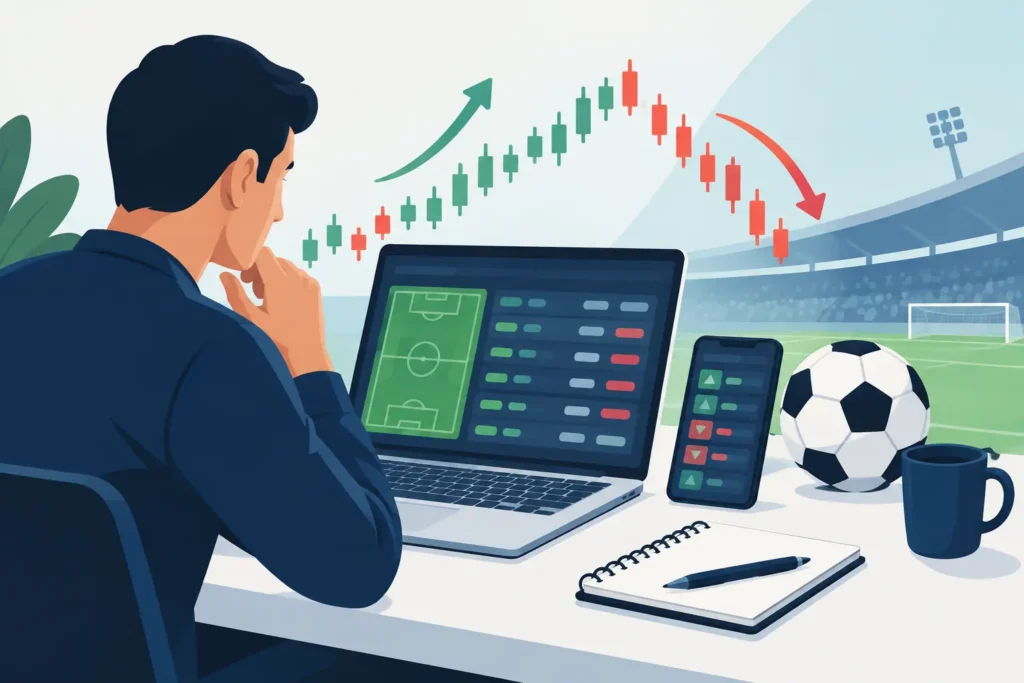
A Premier League favorite opens at 2.05, then drops to 1.82 before kickoff. That change is not background noise. Soccer odds movement can reveal where informed money is going, which team news the market has absorbed, and whether the price you wanted has already disappeared. For bettors who want consistent decisions instead of emotional guesses, reading the market is a serious edge.
Odds do not move because a sportsbook suddenly changes its mind about football. They move because new information arrives, betting patterns develop, and bookmakers manage their exposure. The goal is not to chase every falling price. The goal is to understand why it moved and decide whether value still exists.
What Soccer Odds Movement Actually Means
Soccer odds movement is the change in a betting price between the opening line and the moment you place your bet. A team might open at 2.20 and shorten to 1.95. In American odds, a price can move from +120 to -105. The format changes, but the message is the same: the market now assigns that outcome a higher probability than it did before.
When odds shorten, the implied probability rises. When odds drift higher, the implied probability falls. That may happen in the match winner market, but it also happens with Asian handicaps, totals, both teams to score, cards, and player markets.
A move is not automatically a betting signal. Markets can overreact, especially in high-profile games where recreational bettors pile onto a famous club. Still, a meaningful move gives you a question worth answering: what did the market learn that I may have missed?
Why Football Odds Move Before a Match
The strongest movements usually have a clear reason behind them. Team news is the most obvious example. If a key striker is ruled out, a center-back pairing changes, or a goalkeeper is rested in a cup match, prices can adjust quickly. In leagues where lineups arrive about an hour before kickoff, the final 60 minutes can produce some of the sharpest moves of the day.
Injury news is only one factor. Fixture congestion matters when a Champions League contender is playing its third match in eight days. Motivation matters late in the season, when one team needs points for survival while the other has little left to play for. Weather, travel, coaching changes, tactical shifts, and squad rotation can all affect the number.
Then there is money. Sportsbooks move a price when respected bettors place enough action to challenge their original line or when their overall liability becomes too one-sided. That does not mean every bettor who moves a market is right. It means the bookmaker has a reason to offer a less attractive price than before.
Public betting can move odds too, particularly on weekends and in major leagues. Manchester City, Real Madrid, Barcelona, Bayern Munich, and other globally backed teams attract attention regardless of the matchup. If the crowd is backing a popular favorite, a shorter price may reflect demand rather than a genuine improvement in the team’s true chance of winning.
Read the Price, Not Just the Direction
Many bettors make the same mistake: they see odds falling and rush to back the team. That is how good information becomes a bad bet.
Imagine you rated a home team at a 52% chance to win. That fair probability converts to roughly 1.92 decimal odds. If the sportsbook opened at 2.10, there was a possible value case. If the price falls to 1.78 after heavy action, the market may be confirming the team is strong, but the bet no longer fits your number. You can be correct about the likely winner and still make an unprofitable bet at the wrong price.
This is why disciplined bettors separate prediction from price. A bet asks two questions: what is likely to happen, and does the available odds offer enough return for that risk? The first question without the second is just football opinion.
A move from 2.00 to 1.95 is often minor, especially in a liquid market. A move from 2.40 to 1.95 deserves closer attention. Context decides the importance. Was there confirmed news? Did several major books move at the same time? A line movement across multiple related markets is usually more meaningful than one isolated adjustment.
Opening Odds vs. Closing Odds
Opening odds are the bookmaker’s first public estimate. They can be attractive because the line may not yet reflect every detail, but limits are often lower and prices can be less stable. This is where strong match analysis can find opportunities before the broader market catches up.
Closing odds are the final prices available near kickoff. By then, the market has processed more data: confirmed lineups, press conferences, injuries, weather, and large volumes of bets. Closing markets are typically efficient, especially for major competitions such as the Premier League, Bundesliga, Champions League, and Europa League.
That does not mean bettors should always bet early or always wait. It depends on what drives your selection. If your edge comes from spotting an undervalued team before the market reacts, early odds matter. If your bet depends on whether a star forward starts, waiting is smarter even if the available price becomes shorter.
A useful long-term measure is whether your bets beat the closing line. If you regularly take 2.10 and the match closes at 1.95, you are often getting a better number than the final market consensus. It is not proof that every selection is good, and short-term results can still be painful. But consistently beating the close is far more valuable than celebrating one lucky win.
Watch for Reverse Movement and False Signals
Reverse movement occurs when the visible public narrative points one way but the odds move the other. For example, most social media discussion may favor the home favorite, yet its price drifts from 1.75 to 1.88. That can suggest bigger or more respected money is supporting the away side, or it may simply reflect a lineup concern that the public has not noticed.
Do not treat reverse movement as a magic system. Bookmaker pricing is not a transparent report of every wager. Odds can move to manage risk, compete with other books, or correct an earlier error. A small market can also swing sharply on limited action, making the movement less reliable than it looks.
The better approach is to use movement as confirmation or contradiction. If your statistical work supports an away underdog, the favorite is drifting, and team news weakens the favorite’s lineup, those signals align. If you love an over 2.5 goals bet but the total drops after confirmation that both teams are missing their main attackers, you need to reassess rather than force the original idea.
A Practical Process for Using Odds Movement
Start by recording the opening price when it becomes available. You do not need a complicated spreadsheet at first, but you should know the opening odds, the current odds, and the closing odds for every serious selection. Over time, this reveals whether you are consistently betting at favorable numbers or paying too much because you act late.
Next, attach a reason to every major move. Check confirmed injuries, expected lineups, recent minutes played, travel schedules, motivation, and tactical matchups. Avoid guessing. If you cannot identify a reason, do not invent one just because the odds changed.
Then compare the market move with your own probability estimate. A good betting process should produce a fair price before you look at the sportsbook’s number. Even a rough estimate based on form, expected goals, home advantage, squad strength, and match incentives is better than blindly following the screen.
Finally, protect the bankroll. A falling line can create urgency, and urgency leads to oversized stakes. Keep stake sizing consistent. Missing a price is frustrating, but chasing it at worse odds or trying to recover with a larger bet is far more damaging than passing on one match.
Use the Market as Data, Not a Shortcut
At Tipforwin, the strongest football selections are built around analysis and value, not around copying every market move. Football is mathematics, but it is not a guaranteed formula. A red card, a penalty, or one missed chance can change any result. The advantage comes from repeating sound decisions at prices that make sense over a large sample.
Soccer odds movement gives bettors a live view of what the market believes. Learn to respect it without becoming controlled by it. When the odds move, pause, find the reason, calculate whether value remains, and only then decide if the bet deserves a place in your bankroll.