
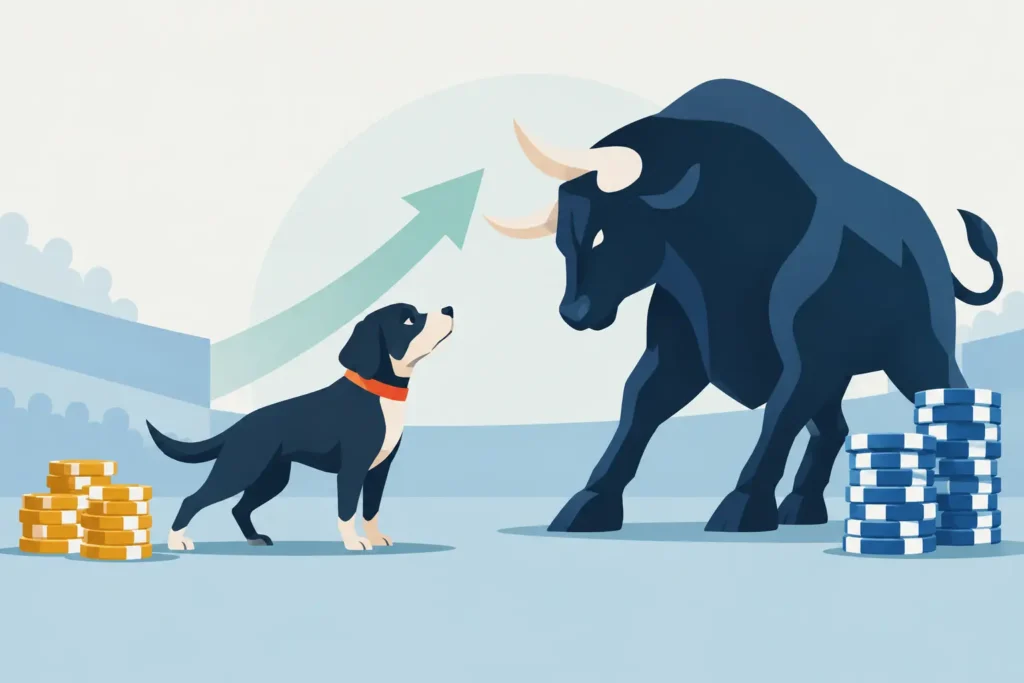
A 3.40 underdog is not automatically a smart bet. Most underdogs lose, and backing them blindly is one of the fastest ways to drain a bankroll. This underdog betting case study shows what changes when a bettor stops chasing big payouts and starts measuring price, probability, team news, and stake size like a serious football investor.
The point is not to find a miracle upset every weekend. The point is to identify occasions when the market has priced a team too low. Football is mathematics. If your estimated chance of an away side winning is higher than the probability implied by the odds, the bet deserves attention – even when the public prefers the favorite.
The Match: A Market That Overrated the Favorite
Consider an illustrative Bundesliga fixture: a top-six home team facing a mid-table away side. The home club had the bigger name, a strong home reputation, and a recent 3-0 win that attracted plenty of public money. Sportsbooks opened the home win around 1.72, the draw at 4.00, and the away win at 4.60.
At first glance, 4.60 looks like a long shot. That price implies an away-win probability of roughly 21.7 percent before the bookmaker margin. A casual bettor sees the league position and moves on. A disciplined bettor asks a better question: does the evidence say the away team wins more often than one match in five?
The answer came from the details behind the headline. The favorite was missing its first-choice center back and had played a demanding midweek European match. Its recent home wins had come against weak attacks, while its expected-goals numbers had been falling. The visitor had lost two recent games, but both were narrow matches against elite opponents. Its away expected-goals differential was positive, its main striker was fit, and its counterattacking style had caused the home side problems in previous meetings.
None of those factors guaranteed an away win. They simply made 4.60 a price worth testing instead of rejecting.
Turning Football Analysis Into a Fair Price
The biggest mistake in underdog betting is confusing a good story with value. “They need the points” is a story. “The favorite has looked tired” is an observation. Neither is enough on its own.
For this case study, the bettor built a fair-price estimate using recent performance data, home and away splits, injuries, schedule congestion, projected lineups, and tactical matchup. The final estimate gave the home side a 48 percent chance to win, the draw a 25 percent chance, and the away side a 27 percent chance.
A 27 percent chance translates to fair odds of about 3.70. With the market offering 4.60, there was a meaningful gap between the estimated probability and the available price. That gap is the reason for the bet.
There is no value if your real estimate is only 20 percent. In that case, 4.60 is still too short. This is why serious betting cannot be built on favorite-bashing or blind faith in outsiders. Your edge comes from being more accurate than the market in specific situations, not from picking the team with the most attractive payout.
Why the Draw Matters
Many bettors assess an underdog only as a win-or-lose proposition. In football, the draw is a major part of the equation. A well-organized visitor may be difficult to beat but still lack enough attacking quality to win consistently.
That is why the bettor also compared alternative markets. The away team or draw in the double-chance market was priced too low to offer enough upside. Draw no bet reduced the downside but also cut the price below the bettor’s calculated value threshold. The straight away win at 4.60 carried more volatility, but it was the market with the strongest mathematical case.
It depends on your model and bankroll. A bettor with lower risk tolerance may prefer Asian handicap positions. A bettor targeting higher odds may accept more losing bets in exchange for a better long-term return. The key is to choose the market because the numbers support it, not because it feels safer.
The Stake: Small Enough to Survive Variance
The bettor’s bankroll was $1,000. Despite the tempting 4.60 price, the stake was $10 – exactly 1 percent of the bankroll.
That discipline matters because underdog betting produces losing streaks. Even a real 27 percent win probability means the bet loses roughly three times out of four. You can be right about the value and still watch several selections lose in a row. Anyone staking 10 percent of their bankroll on each outsider will eventually confuse variance with bad luck and destroy their betting capital.
At $10, the potential return was $46, including stake. The possible loss was known and controlled. The bettor did not double the stake after a recent losing run, and did not raise it because the odds looked exciting. One bet should never have the power to decide your month.
For most bettors, a flat staking plan between 0.5 percent and 2 percent per selection is easier to maintain than aggressive systems. The exact number can vary, but the rule is simple: stake according to bankroll, not emotion.
What Happened – And What Actually Matters
The away team won 2-1 after scoring on a transition early in the second half. The $10 stake returned $46, producing a $36 profit.
That result does not prove the analysis was perfect. The favorite could have converted an early chance, a referee decision could have changed the match, or a late equalizer could have erased the payout. Betting analysis should be judged by the quality of the decision at the time of placement, not only by the final score.
A single winning underdog bet is not a strategy. To test whether the approach has merit, the bettor tracked a sample of 20 similar selections over several weeks: away underdogs priced from 3.20 to 5.00, backed only when the estimated win probability was at least four percentage points above the market-implied probability.
The sample produced five winners from 20 bets. That 25 percent strike rate may not look impressive, but the average winning price was 4.12. With $10 staked on every selection, total stakes were $200. Returns from the five winners totaled $206, creating a modest $6 profit before any adjustments for changing prices or limits.
The result is intentionally unglamorous. A profitable method will not necessarily generate a huge return over 20 bets. It can also lose over 20 bets while still being sound. The sample is too small to claim a permanent edge, but it gives the bettor something more useful than a highlight reel: records.
The Real Lesson From This Underdog Betting Case Study
The case study exposes three habits that separate calculated underdog betting from random long-shot chasing. First, price comes before prediction. You can believe the favorite is likely to win and still find value on the outsider if the market has overstated that favorite’s chance.
Second, context beats reputation. Public bettors often pay too much for famous clubs, recent scorelines, and home-field narratives. Strong football analysis looks beneath that surface at lineup availability, chance creation, defensive structure, rest days, motivation, and the style clash that could make a favorite uncomfortable.
Third, every bet needs a record. Track the opening odds, odds taken, your estimated probability, stake, result, and closing price. If the market regularly moves in your direction after you bet, that can be a useful sign that your numbers are identifying value. If your picks consistently drift and lose, you need to challenge the method rather than protect your ego.
A Better Way to Find Underdog Opportunities
Start by screening matches where the public has an obvious reason to back one side: a famous club, a recent winning streak, a title race, or a popular striker. Those matches are not automatic fades, but they are where inflated prices can appear.
Then build the case against the favorite and for the underdog. Check whether the expected lineup changes the matchup. Compare recent expected goals rather than only final scores. Look at home and away performance separately. Ask whether a midweek fixture, travel schedule, or tactical weakness creates a realistic path to an upset.
Finally, calculate the probability required by the odds. At 4.00, you need to believe the team wins more than 25 percent of the time, allowing for the bookmaker margin. If you cannot explain why your estimate is higher, pass the match. There will always be another fixture.
Tipforwin focuses on this disciplined search for better football prices, not fantasy promises. The best selections are often the ones supported by clear data, sensible odds, and a stake you can afford to lose.
A losing underdog bet does not mean the process failed, and a winning one does not mean you have found a shortcut. Keep the stake controlled, demand value before action, and let a large record of decisions tell you whether your football reading is genuinely profitable.