
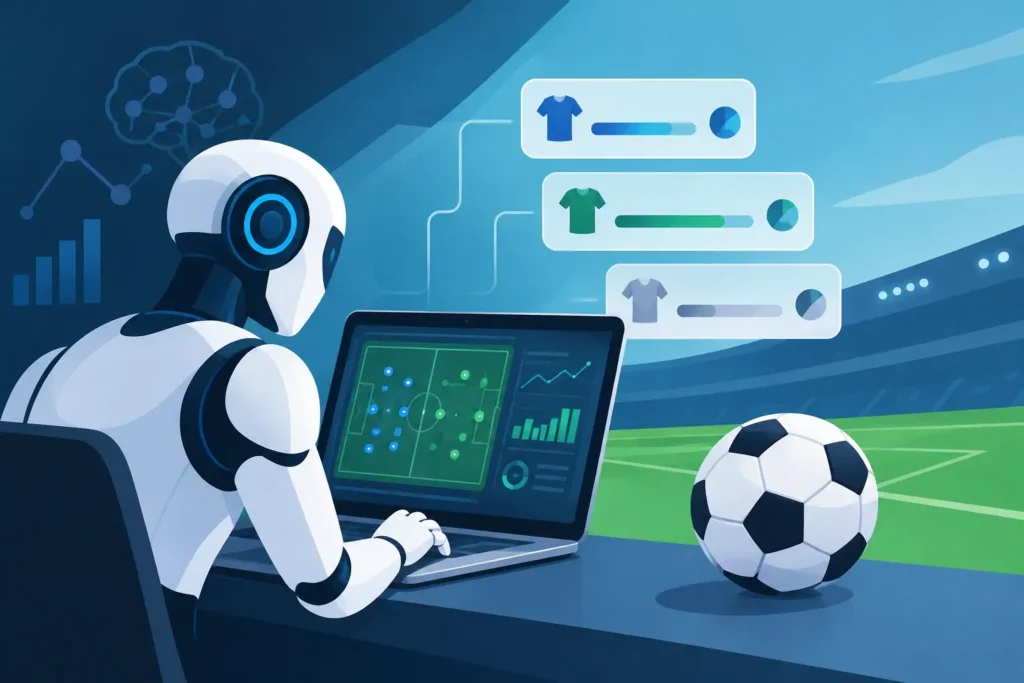
A model can process a full weekend of Premier League, Bundesliga, Champions League, and Ligue 1 fixtures before most bettors have finished checking the headlines. That does not mean it has found a winning bet. The real advantage of AI football predictions 2026 is not magic scorelines or guaranteed accumulators. It is the ability to turn huge amounts of match data into a clearer betting decision – then compare that decision with the odds.
Football is mathematics, but betting is pricing. If the market gives a team a 55% chance to win and your analysis puts that chance closer to 62%, there may be value. If the price already reflects the team’s quality, the popular pick can still be a bad bet. That is the standard serious bettors should use when evaluating AI-driven predictions.
What AI football predictions 2026 actually measure
Good football forecasting models do more than count recent wins. They look for repeatable signals that can explain performance better than a league table alone. Expected goals, shot quality, chance creation, defensive pressure, possession zones, set-piece output, home and away splits, player availability, rest days, and fixture congestion can all affect a match probability.
The strength of AI is speed and consistency. A model can identify that a mid-table team is creating more high-quality chances than its results suggest, or that a league leader has been winning narrowly while conceding too many dangerous opportunities. Those details matter when the market is offering odds above 1.8, where a bettor needs more than a famous badge to justify the stake.
Machine learning can also find relationships that are easy to miss when you only watch highlights. For example, it may recognize that a team’s scoring output drops sharply against aggressive pressing sides, or that an opponent’s defense becomes vulnerable late in matches after a short turnaround. This is useful information, especially across multiple leagues where manual research can become rushed.
But a prediction model is only as useful as the data behind it and the judgment applied after it. Old data, inaccurate injury information, weak league coverage, or a model trained only to pick winners can produce confident-looking but unprofitable picks. The goal is not to admire the technology. The goal is to use it to find a price the market has underestimated.
The difference between a prediction and a value bet
Many bettors make the same mistake: they see an 80% predicted chance of a home win and assume it must be the best bet. Not necessarily. At odds of 1.20, that selection may offer no margin for error. One red card, one missed penalty, or one tactical surprise can destroy a price that was never attractive in the first place.
A value bet begins with probability. If an AI model estimates a 57% chance for Both Teams to Score, the fair odds are roughly 1.75. If the bookmaker offers 1.95, the gap is worth investigating. If the bookmaker offers 1.60, the model may still expect the outcome, but the bet is likely not worth taking.
This is why the strongest AI football predictions 2026 should include a market view, not just a predicted result. A 1X2 pick, over/under selection, Asian handicap, or Both Teams to Score recommendation needs context: What probability does the analysis assign? What odds are available? Is there enough value to absorb normal losing runs?
There is no need to force an opinion on every match. Passing is part of profitable betting. The best opportunity may be a low-profile Bundesliga fixture with a mispriced total rather than the biggest Champions League game of the night. Bettors who chase action usually pay for it through poor prices.
Where AI can help most in football betting
AI is particularly effective when it supports repeatable tasks. It can screen a large fixture list, flag teams whose underlying numbers differ from their results, and update estimates as new lineups or injuries are confirmed. That gives disciplined bettors a stronger starting point than gut feeling alone.
It is also valuable for market selection. Some teams are difficult to trust in the win market but reliably create open matches, making goals markets more logical. Others protect leads well, produce few clear chances, and may suit an under bet. The model can compare patterns across hundreds of previous matches instead of relying on a memory shaped by one dramatic result.
Live betting is another area where fast analysis has a role. Match events, territory, shots, substitutions, and game state can change the true probability of a goal or result. Still, speed does not excuse bad discipline. In-play odds move quickly because bookmakers are processing the same events. Bet only when the updated price is better than your calculated probability, not because the match suddenly feels exciting.
What AI cannot see clearly
Football remains a human game. A model may account for an injured striker, but it cannot always measure how a new manager has changed the dressing room, whether a player is carrying an unreported fitness problem, or how seriously a club will approach a cup fixture. Data gives an edge only when it is interpreted in context.
Lineups are a major example. A pre-match model may favor a team based on season-long performance, but a rotation-heavy starting eleven can change the entire case. The same applies to weather, travel, motivation, and tactical matchups. A relegation battle, a second leg in Europe, or a derby can create incentives that are not fully captured by raw numbers.
There is also the issue of false precision. A prediction of 2-1 may look authoritative, but football scores are volatile. A better use of AI is to estimate ranges and probabilities: a strong likelihood of goals, a moderate away-win edge, or a home side that is overpriced in the draw-no-bet market. Treat exact-score output as one scenario, not a promise.
How to use AI predictions without destroying your bankroll
A sound system protects you from the worst habit in betting: increasing stakes because you feel certain. Even the best model loses bets. A 60% probability still means the outcome fails four times in ten on average. That is why stake sizing matters more than a single “sure” pick.
Keep your bankroll separate from money needed for everyday life. Use a consistent stake, such as 1% to 3% of your betting bankroll, based on your risk tolerance. Record every bet with the market, odds, stake, closing price, and result. After enough bets, you can see whether you are actually beating the market or simply remembering the wins.
Avoid building long accumulators from AI recommendations just because each leg looks statistically strong. Every extra leg multiplies risk and often removes the value you found in individual markets. Singles give you a clearer way to measure performance. Small doubles can have a place, but they should be selective rather than a daily habit.
At Tipforwin, the focus should be the same: use data-backed picks as a decision tool, not a reason to gamble without limits. Paid and free predictions are most useful when they save research time, explain the betting angle, and fit a consistent bankroll plan. No service can remove variance, but a disciplined process can stop variance from controlling your behavior.
A practical checklist before placing an AI-backed bet
Before you commit, ask four direct questions. Does the predicted probability beat the implied probability in the odds? Is the data current, especially for injuries and expected lineups? Does the suggested market fit the tactical profile of the match? Can you place the bet at a stake that remains comfortable if it loses?
If one answer is weak, wait. The market will offer more matches tomorrow. Serious bettors do not need to prove they can predict every game. They need to identify enough well-priced opportunities to make the numbers work over a long series of bets.
AI will keep improving in 2026, with faster lineup analysis, broader data feeds, and better modeling of player-level impact. The bettors who benefit most will not be those who blindly follow every algorithm. They will be the ones who understand the odds, demand value, track their results, and stay patient when a good bet loses. That is how football data becomes a betting method instead of another source of noise.