
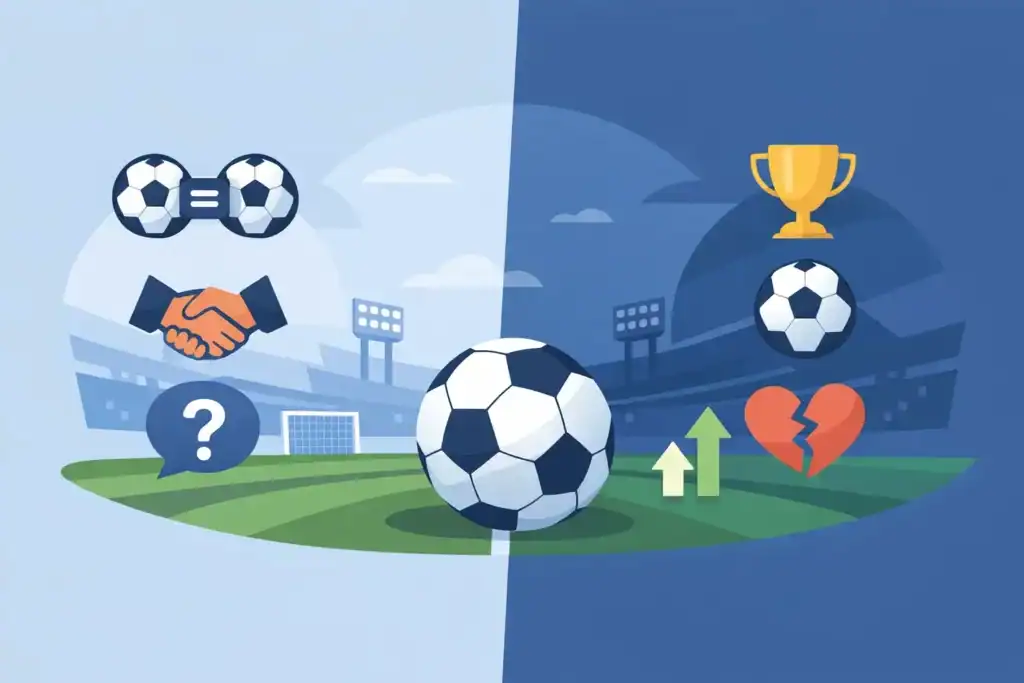
A tight Premier League match at 1-1 in the 75th minute exposes the real difference between draw no bet vs 1×2. If you backed the stronger side in the 1×2 market, a draw means a complete loss. If you took that same team on draw no bet, your stake is returned. That protection costs you shorter odds, but for disciplined bettors, it can be the difference between chasing results and managing risk like a serious player.
What Draw No Bet and 1×2 Actually Mean
The 1×2 market is the standard full-time result market. The 1 represents a home win, X represents a draw, and 2 represents an away win. You pick one outcome, and only that exact outcome must happen after 90 minutes plus added time. Extra time and penalties do not count unless the sportsbook states otherwise.
Draw no bet is simpler than it sounds. You choose either the home team or the away team. If your selection wins, the bet wins. If the match ends in a draw, the stake is refunded. If your selection loses, the bet loses.
For example, imagine Barcelona are away to Atletico Madrid. Barcelona might be priced at 2.40 in the 1×2 market and 1.72 on draw no bet. A Barcelona victory pays more in 1×2 because you accept the risk of a draw. The draw no bet price is lower because the bookmaker removes that draw risk.
The settlement is the same: win on your team, money back on a draw, loss if your team lose.
Draw No Bet vs 1×2: The Core Trade-Off
There is no automatic winner between these two markets. The right choice depends on the probability of a draw, the odds available, the match situation, and your own betting objective.
With 1×2, you are paid for being precise. You believe one side will win outright, and the higher odds compensate you for taking all of the risk. This market is often the better play when the favorite has a genuine tactical edge, strong recent performances, and the price still offers value.
With draw no bet, you sacrifice some payout to protect your bankroll. It is useful when your analysis points toward one team being better, but the draw remains a highly realistic outcome. Think of an evenly matched derby, an away favorite facing a difficult venue, or a knockout first leg where neither side wants to overcommit.
Here is the practical comparison:
| Market | Your team wins | Match draws | Your team loses | |—|—|—|—| | 1×2 | Bet wins | Bet loses | Bet loses | | Draw no bet | Bet wins | Stake refunded | Bet loses |
The refund is not a profit. That matters. A draw no bet selection that draws does not move your bankroll forward, but it stops a potentially correct read from becoming a loss just because neither team found a winner.
When 1×2 Offers More Value
Use the 1×2 market when your model or match analysis says the win probability is strong enough to justify the extra risk. Do not choose it simply because the odds look more exciting. Bigger prices are not better prices unless they are bigger than the true chance of the outcome.
Suppose Liverpool are 1.95 to win at home, while their draw no bet price is 1.38. If you rate Liverpool’s chance of winning at 55%, the 1×2 price may be worth serious attention. A 1.95 price implies roughly a 51.3% chance before the sportsbook margin. If your assessment is accurate, there is a potential edge.
But if Liverpool have key injuries, face a low-block opponent, and have drawn three of their last five league matches, that 55% estimate may be wishful thinking. In that case, draw no bet may better reflect the uncertainty – or the correct decision may be no bet at all.
The strongest 1×2 situations usually combine a clear quality gap with conditions that reduce draw potential. Look for a favorite with a reliable scoring profile, a motivated opponent that cannot sit back, and team news that supports the expected result. A must-win match can create those conditions, although pressure can also make favorites tense and inefficient.
When Draw No Bet Is the Smarter Football Bet
Draw no bet earns its place when you see a team as the more likely winner but do not want a stalemate to destroy the position. It is particularly effective in leagues and fixtures where draws are common and margins are small.
Away teams are a classic example. An away side may be better on paper, have stronger attacking numbers, and still face a difficult match because travel, crowd pressure, and a cautious home setup raise the draw probability. Backing the away team on draw no bet can be a rational way to follow the stronger side without pretending the match is one-sided.
It also works well when the favorite is inconsistent but has a higher ceiling. A talented team that can dominate on its day may still be vulnerable to a 0-0 or 1-1 result. If your analysis says they are unlikely to lose but not certain to win, draw no bet fits the logic.
That said, do not turn draw no bet into a habit just because it feels safer. If the odds are too short, you may be paying heavily for protection you do not need. Betting a 1.30 draw no bet favorite repeatedly requires a very high win rate to produce worthwhile returns. Safety without value is still a bad bet.
Read the Odds, Not Just the Team Names
The market is already aware that Real Madrid, Bayern Munich, or Manchester City are strong teams. Your edge does not come from recognizing famous clubs. It comes from deciding whether the price has properly accounted for form, injuries, scheduling, motivation, and matchups.
A useful way to compare draw no bet and 1×2 is to ask one direct question: how likely is the draw relative to the price reduction? If the 1×2 odds fall sharply when you move to draw no bet, the bookmaker is signaling meaningful draw risk. That does not automatically make draw no bet correct, but it tells you where your analysis must focus.
Check how each side creates chances and how it handles leads. Two teams with low scoring rates, organized defenses, and cautious coaches make a draw more plausible. By contrast, a matchup involving aggressive pressing, vulnerable defensive transitions, and teams that need three points can be less draw-friendly.
Historical head-to-head records can add context, but they should never lead your decision. Managers change, squads change, and a match played two years ago rarely explains the current price. Recent performance data, absences, tactical fit, and incentives matter more.
A Simple Stake and Return Example
Assume you stake $100 on an away team.
At 2.20 in the 1×2 market, a win returns $220, for a $120 profit. A draw or loss costs the full $100 stake.
At 1.65 on draw no bet, a win returns $165, for a $65 profit. A draw returns your $100 stake, while a loss still costs $100.
The decision is not whether $120 is better than $65. Of course it is. The real decision is whether the additional $55 potential profit fairly compensates for losing the whole stake whenever the game ends level.
That is why serious betting is mathematics, not emotion. You are not choosing the market that feels safest or the one that promises the largest return. You are choosing the price that gives your probability estimate the best long-term expectation.
Common Mistakes That Hurt Returns
The first mistake is treating a stake refund as a winning bet. It is not. Too many refunded selections can leave you with little progress, especially when you are betting at very low odds.
The second is taking draw no bet on every away favorite. Some away teams are strong enough to justify the 1×2 price, particularly when the home team is depleted or forced to attack. Others are overpriced because bettors trust the badge more than the evidence.
The third mistake is ignoring the league. A 1×2 favorite in a high-scoring competition may have a different draw profile from the same-priced favorite in a more tactical, low-scoring league. Market choice should reflect the football being played, not a fixed betting rule.
Finally, avoid increasing stakes just because draw no bet appears protected. You can still lose the full stake when your team loses. Set a consistent unit size, track each market separately, and judge results across a meaningful sample rather than a single weekend.
Build the Market Choice Into Your Process
Before placing a bet, decide what your analysis actually says. If you believe a team wins more often than the market implies, 1×2 may be the value play. If you believe they are stronger but a draw is a significant obstacle, draw no bet can protect a sound read. If neither price gives you enough room, walk away.
Tipforwin focuses on that disciplined approach: assess the match, respect the odds, and avoid forcing action on every fixture. The best bettors do not need to be right about every game. They need to repeatedly find prices where their reasoning is stronger than the market.
The next time you want a bigger 1×2 payout, pause and price the draw honestly. That one habit will make your football betting decisions sharper, calmer, and far more sustainable.